Thursday, June 14, 2012

The Glass Castle, Jeannette Walls (2005)

Reviewer: BeezusKiddo

Rating: 5 of 5 glorious pierogies


Review: I find this to be an incredibly difficult review to write. Not because the book was tragic (it was), or because it was inspiring (it was), but because it is so incredibly complex that I don't know where to start.

Glass Castle is Walls' memoir of her eccentric but impoverished childhood. Other reviews I've read point out that this memoir demonstrates how Walls and her siblings ultimately thrived, other reviews point out how much Walls and her siblings suffered. All of these things are true. One review characterized Walls' feelings towards her parents as "warm," which they were sometimes, but she also seemed to have some resentment and sorrow.

Walls' father was a daydreaming, and at times violent, alcoholic, and her mother an artist. It's apparent there were some untreated mental health problems with both parents, but what really struck me were their deep and unapologetic personality flaws. Both parents were unshakeably selfish.

In one instance, the Walls siblings literally had no food, were digging in trash cans and picking through the woods to find something, anything to eat. Walls notices that her mother was getting fatter, and sees her mother sitting in bed under a blanket, and seemingly fishing around under the blanket then putting things in her mouth....and the Walls children discovered that as they were starving, their mother was hoarding and gorging herself on chocolate. In multiple instances the mother, despite being trained and qualified and hired to teach, refuses to get out of bed and go to work, because she wants to stay home and paint instead. Here and there Walls' mother would say things like "It's time to do something for me" and reading that would send me into a blind rage, because it seemed that Walls' mother only did things for herself anyway. The most egregious example of Walls' mother's selfishness came at the end of the book, and it made me so bitter that I don't want to divulge it as a spoiler.


Walls' father was even worse. He was an unapologetic alcoholic, with grandiose dreams and no sense of anyone but himself. He'd wrap himself so tightly in his absurd fantasies and conspiracy theories that he was blind to the danger, and at times sorrow, he put his children through. He was so far gone that it was easier to brush him off as unloveable and hopeless. Ugh, I don't even want to waste time talking about him in this review, even though he's a driving force.

Despite all these negative things, the book was amazing. I read the whole thing over 3 nights (despite working each night til nearly 10. I've had a tired week). The bitterness comes purely from me, as the reader, and not from Walls. She had a number of happy times in her childhood, she had a number of times that were so incredibly bad they were just ridiculous. She generally did her best to make the best of things, but she comes off as grounded, not Pollyanna-ish. Her relationship with her siblings is incredible, indeed adversity brought them together, but it is more incredible that she seems to have come to terms with her parents and her childhood. It's not even an issue of forgiveness and closure, she approaches it more with a perspective of "This is where I came from, and it's strange and different, but it was mine."

I was on the fence about re-upping my Pittsburgh Speakers Series subscription for 2012-13, but since Jeannette Walls will be speaking, I simply have to go. This woman is amazing.

Saturday, June 9, 2012

The Partly Cloudy Patriot, Sarah Vowell (2002)

Reviewer: BeezusKiddo

Rating: Very nearly 4 pierogies

Review: Sarah Vowell is a nerd, and she's rather proud of it. Not a skinny-jeans hipster kind of nerd, but a nerd that likes to read every word on every placard in a history museum, and then talk about everything she saw for the entire 4 hour drive home.  Vowell LOVES American history, and reading A Partly Cloudy Patriot is like having a cup of coffee with your friend, and chatting about her favorite subject.


Vowell wrote Patriot in the months after September 11, 2001, but the book does not beat you over the head with the patriotism of the moment. In fact, with the exception of one chapter on the topic, it's not obvious to the reader that the book was written so close in time to the tragedy. The "Patriot" of Vowell's world is neither gun toting nor chaw-spittin, but instead reflects on the accomplishments of Teddy Roosevelt, and explains the insulting absurdity of public figures' love of comparing any act of civil disobedience to Rosa Parks (insulting to the true heroism of Rosa Parks' act, that is).

Vowell is neither preachy nor boring. Her chapters are short enough that as topic wanes, she switches to another. Her tone is conversational and friendly. I read the book over 3 nights, so it was very quick going. I'd like to read her other books, but there is not an urgent plot line compelling me to pick up the next one RIGHT NOW.

Vowell would be an entertaining pal. If you're not in the mood to pick up one of her many books, at least try to catch her fairly regular appearances on This American Life.

Monday, June 4, 2012

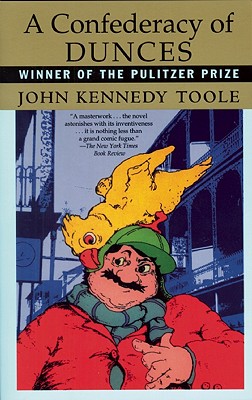
A Confederacy of Dunces and Insurgent

Reviewer: BeezusKiddo

John Kennedy Toole's A Confederacy of Dunces (1980) and Veronica Roth's Insurgent (2012) are so completely opposite that I thought it would be interesting to discuss them side by side.


Rating: 3 homemade high-quality pierogies. Well, maybe 4.

A Confederacy of Dunces is a novel by an author who loved language, and who was exceptionally skilled with language. Nothing really happens in the plot-- the main character, Ignatius Reilly, is a slovenly buffoon, who is forced to find employment after his mother causes some property damage while driving in her signature drunk fashion. Reilly first works at a pants factory, where he gets canned. Then he works as a hot dog vendor, and gets canned. None of this gets him down. The world just does not understand his GENIUS.

Reilly was funny at first, but eventually got on my nerves, mostly because I know an in-real-life Ignatius Reilly. I love a good comeuppance. Reilly never gets one, despite his selfish, egomaniacal, bombastic ways, and neither has the in-real-life Reilly I know. The lack of retribution was grating.

Confederacy has been praised as the greatest comic novel of the 20th century. I certainly thought it was funny, but I was distracted from truly appreciating its humor by my annoyance that Reilly never gets what should be coming to him.

The true delight of Confederacy is the artful language. Some gems:

In spite of whatever spiritual qualities it may possess, skid row is definitely sub-standard in the matter of physical comfort, and I seriously doubt whether my substantial and well-formed physique would easily adapt to sleeping in alleys. I would definitely tend to hang over park benches. Therefore my size itself is a safeguard against my ever sinking too low within the structure of our civilizations. [After all, I do not believe that one must necessarily scrape bottom, as it were, in order to view his society subjectively. Rather than moving vertically downward, one may move horizontally outward toward a point of sufficient detachment where a modicum of creature comforts are not necessarily precluded. I was there--on the very rim of our age-- when my mother's cataclysmic intemperance, as you well know, catapulted me into the fever of contemporary existence. To be quiete honest, I must say that since then things have been getting worse and worse. Conditions have deteriorated.

and

I recommend Batman especially, for he tends to transcend the abysmal society in which he's found himself. His morality is rather rigid, also. I rather respect Batman.

These aren't even the BEST passages. There are several more passages that are significantly funnier and more brilliant, but they are too crass for me to post here. You'll have to go read them for yourself.


Rating:1 burnt Mrs. T's Pierogi. Blech.

Whereas Confederacy is a book of amazing language and no plot, Insurgent is all action but trite language.

Insurgent follows Beatrice Prior as she leads some sort of revolution or uprising or something in the post-apocalyptic America that has been divided into separate factions according to dominant personality traits ("Candor" values honesty above all else, "Erudite" values knowledge above all else, "Dauntless" values courage above all else, "Amity" values peace above all else, and "Abnegation" values selflessness above all else.)

I've read a few reviews that compare the Divergent/Insurgent books to The Hunger Games, but Suzanne Collins as a much more compelling storyteller than Roth. Divergent kept me interested by its fast plot and novelty, but the novelty has run out in this second book. The plot is again fast-paced, but it goes in too many directions all at the same time, and there are so many characters (and none of those ever-helpful one liner reminders of who the heck anyone is) that it's easy to get lost/bored.

Insurgent is mostly told through dialog, except the dialog is overwhelmingly banter, and not even witty banter. It reminded me of the kinds of short stories I wrote in high school (which I long since abandoned, because they were terrible). I really don't like saying bad things about a book, because I know the author worked darn hard to crank out and edit the story, and I know that if the author herself weren't proud of it, she would have never had it sent to print, but I just can't like this book.

Roth credits all kind of reviewers and friends at the end of the book...and none of them could break it to her that this book is terrible? The TWIST at the end was very predictable, and the promise of learning more about that plot line isn't even enough to keep me interested in reading the next one. If anything convinces me to read the third one (when it does come out), it would just be for the sake of finishing something I have started, not because I'm enthralled by the world of Beatrice Prior.

Wednesday, May 23, 2012

Great Expectations, Charles Dickens, 1860-1861

Reviewer: BeezusKiddo

Rating: 3.5 Pierogies, with the potential for more if read in a reading group, with the opportunity to discuss the characters and plot

Review: I DID IT! I can't believe I successfully made it through this book! And I LIKED it!


Great Expectations is the story of Pip, a penniless orphan, who unexpectedly comes into "Great Expectations" by an unknown benefactor. Great Expectations follows Pip's rise and fall from wealth, and his pining for the beautiful but cold hearted Estella.

Great Expectations was published as a serial. It reads like one, with plot lines and characters weaving in and out. There have been many movie adaptations of the book (and another expected soon, with Helena Bonham Carter as Miss Havisham), but I think Great Expectations would do perfectly as a mini (or not-so-mini) series. There probably already is one, I just need to do a little digging. Great Expectations definitely has the "feel" of TV.

The cast of characters is huge and colorful, and some have multiple names, which make them hard to track. Not surprisingly, Great Expectations is written in 19th century England's conversational language, while equally colorful as the characters, is sometimes hard for this 21st Century American girl to understand. To get through the language barrier, it would be great to read Great Expectations as a regularly-meeting group, where you stop and discuss each chapter or two.


Dickens is known for his memorable, crazy characters, and Great Expectations is a shining example of his talent. My absolute favorites were the crazed and embittered Miss Havisham, the flawed but lovable Pip, and Joe Gargery, who didn't have a mean bone in his body.

Dickens' works have aged into the Public Domain, so they are free downloads on a Kindle, as are many other classics. With all the new and exciting bestsellers, I've always got a bedside table groaning under the weight of my "to read" pile, but it's also worth it to take a step back, and visit the classics. These books are classics for a reason, and although the language can sometimes be a bit tough, the well-woven story is worth it.

Thursday, May 3, 2012

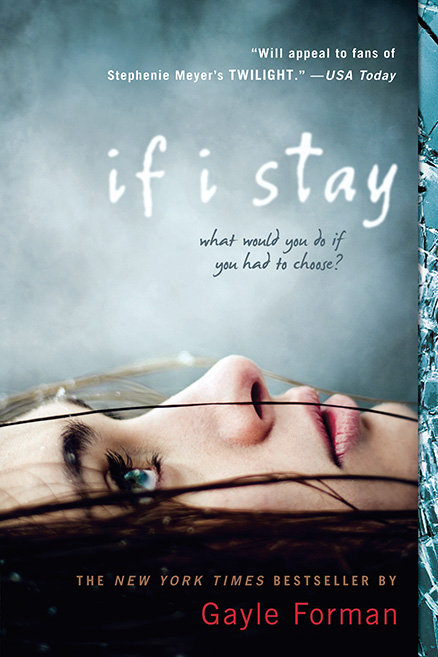
If I Stay, Gayle Forman (2009)

Reviewer: BeezusKiddo

Rating: 2 boring, sad pierogies.

Review: I'm a big fan of Young Adult lit-- it's entertaining, quick to get through, and doesn't require too much thinking. This one was just not a winner with me.


If I Stay follows Mia, a 17 year old Juilliard hopeful, in the 24 hours following the terrible car accident that killed her family, and leaves her in limbo, to decide whether to stay in this world, or pass on to the next.

 The author's biggest accomplishment here is also her biggest liability. Forman creates an incredibly authentic teenage narrator. The language is direct, and the narrator conceptualizes her world in naieve, simplistic categories. To me, this was maddening, because 17 year olds are immature and stupid, I do NOT want to be stuck in a 17 year old's thoughts. I spent most of this book gasping "ugggh I was just like that" and wanting to crawl under something and hide from embarrassment.

So in writing from a 17 year old's perspective, Forman does it well. Much TOO well. She deserves some credit for that feat, but it's not a feat that makes me want to pick up her other books.

 I didn't find the plot compelling, either. If the rest of my family died in a car accident, and I was horribly horribly injured, that's it, let me die, decision made. There's no struggle there for me. (Sidenote: Mr. Beez LOVES shows about the apocalypse and doomsday preppers. It makes him completely insane that my apocalypse preparedness plan is "I will just die." I am not interested in wandering the earth in desperation, struggling for survival.)

YA is a hot genre right now, and there is no shortage of interesting new authors. If you're interested in picking up a YA novel, there are plenty of other better ones out there for you.

Friday, April 13, 2012

A Confederacy of Dunces; John Kennedy Toole (1980)

Reviewer: Elle Ewok

Rating: 5 Pierogies

Review: My little brother, the literary genius, gave me A Confederacy of Dunces for my birthday. He has a 100% success rate in picking out books for me and this is no exception.

The backstory of A Confederacy of Dunces is worth noting because it is so remarkable. The author was unable to get the book published during his life time and committed suicide at the age of 32. It was published eleven years later and only after his mother successfully harassed novelist Walker Percy into reading the manuscript. Percy was so impressed with the book he had it published by Louisiana State Press (800 copies originally). A year later, Toole was posthumously awarded the Pulitzer Prize for fiction for A Confederacy of Dunces. Since then the book has developed a huge cult following and is considered to be one of the best comedic novels in American literature.

A Confederacy of Dunces tells the story of anti-hero Ignatius J. Reilly, a fat, over-educated weirdo who spends his time harassing his mother and writing indictments on the perversions and failures of society. He is, quite possibly, my favorite character ever written even though he is pretty much a horrible person; a hilarious horrible person. The rest of the book is populated with quirky, politically incorrect (by today's standards) characters whose paths all cross thorughout the book in amusing and clever ways. The book takes place in New Orleans and the culture, language and lifestyle of New Orleans seeps into every word of the book.

The plot line of the book is secondary to the characters and humor but is basically as follows: Ignatius is forced to get a job after his drunk mother causes damage to private property in a car crash and has to pay the bill - shenanigans of all manner ensure in his efforts to enter the workforce. Ignatius has an uncanny ability to cause trouble that reverberates throughout New Orleans in unexpected ways. The humor in this book is the most consistent, clever and entertaining I have ever read. I laughed out loud on almost every single page. The humor is dark but not too dark, really clever but not pretentious, and the writing is actually extremely literary. Although it is a comedy A Confederacy of Dunces, is an extremely literary book and I was blown away by the skill of the author. One can only regret what other masterpieces were lost when he chose to end his life as such a young age.

Hollywood has been trying to make A Confederacy of Dunces into a movie for years unsuccessfully. In fact, the part of Ignatius has come to be considered cursed after numerous actors considered or slated for the part died tragically (Jim Belushi, Chris Farley, John Candy). A version set to be directed by Harold Ramis in the 80s fell apart and a new version set to star Will Farrell in a fat suit has been on hold since at least 2006. I actually could hear Will Farrell delivering some of the lines in my mind as I read the book and I bet it would be hilarious.

There is not much more I can say other than I absolutely adore this book and I want to read it again almost immediately. I am definitely adding it to my all-time-favorite book list. In closing I will leave you with some wisdom from Ignatius J. Reilly:


  • "My respiratory system, unfortunately, is below par. I suspect that I am the result of particularly weak conception on the part of my father. His sperm was probably emitted in a rather offhand manner."
  • "I am at this moment writing a lengthy indictment against our century. When my brain begins to reel from my literary labors, I make an occasional cheese dip."
  • "Your total ignorance of that which you profess to teach merits the death penalty. I doubt whether you would know that St. Cassian of Imola was stabbed to death by his students with their styli. His death, a martyr’s honorable one, made him a patron saint of teachers."
  • "Veneration of Mark Twain is one of the roots of our current intellectual stalemate."               
  • "It's not your fate to be well treated ... You're an overt masochist. Nice treatment will confuse and destroy you."
  • "Mother, I must attend to my bowels. They are revolting against the trauma of the last twenty-four hours."
  • "Like a bitch in heat, I seem to attract a coterie of policemen and sanitation officials. "
  • "Go dangle your withered parts over the toilet!"
  • "This liberal doxy must be impaled upon the member of a particularly large stallion."
And my personal favorite...
  • "Filth ... How dare she pretend to be a virgin. Look at her degenerate face. Rape her!"

Thursday, March 22, 2012

The Hunger Games Trilogy; Suzanne Collins (2008-2010)

Reviewer: Elle Ewok

Rating: 4 Piergories

Review: I generally avoid young adult fiction unless it begins with the words "Harry Potter" but after years of hype and my friends carrying on about The Hunger Games books I decided to jump in. They are not that long and to quote my almost-brother-in-law, "those are the books with 6 words per page, right?" In short, I figured it wouldn't be that much of an investment if they turned out to be stupid.

The Hunger Games is a certified cultural phenomenon so I am sure you are aware of the plot. It is a dystopian story about North American sometime in the future. A rich capital in the Rocky Mountains rules and subjects everyone else in the country (divided into 12 Districts) to poverty and essentially slavery. To punish the Districts for a rebellion 75 years earlier, the Capital hosts the annual Hunger Games. One girl and one boy from each District are drafted to compete to the death in an outdoor arena that is full of death traps and misery. It is like a futuristic Roman Colosseum. The Hunger Games are both a punishment and a form of intimidation and control.

As I read the books I noticed they read more like movie scripts than novels. I was not surprised to later find out that the author was a television writer. I really enjoyed these books but I think this is a story meant to be told on the big screen. I am thrilled the movies are being made and based on the trailers, the first one at least looks excellent.


The first book is the tightest and the best. The second and third book are not as good as the cast of characters and scope of the story get big and somewhat unwieldy. That said, they are still incredibly fast-paced and entertaining. I was a bit worried because when I initially heard the plot (kids fighting to the death) it seemed so incredibly silly that I couldn't imagine it would work - but it did.

I think my favorite part of The Hunger Games Trilogy is that the main character and narrator is far from perfect. She is incredibly brave, strong and capable of incredible acts of love and selflessness. That said, she is also insensitive, self-absorbed, a bit mean-spirited and short-sighted/impulsive at times. In short, she is a deeply flawed person that is capable of great things - just like most people. I like how even though the story is told through her eyes and she is the catalyst for so much of the action in the story, I would argue she is not the hero of the story. In my opinion, someone else is - I liked that. Also - the book doesn't shy away showing how badly the trauma of war (inside the games and out) have affected her and others. These are not characters who can be victims of, and the cause of, numerous horrors of war without significant scarring.

Obviously, I also like that the main characters came from District 12 (ie Appalachia). Yay for Appalachia - Did you know that Pittsburgh is the Paris of Appalachia?

As I was reading the third book, I was kind of disappointed although I still was enjoying it. The story just started declining in the second and third books but I am not sure why exactly. 3/4 of the way through the last book I prepared myself for a lackluster ending because I had heard less than great things about the third book and I didn't really like where I saw the story heading. However, the end of the third book really won me over - I loved it. The ending is...well..realistic. The scars of trauma and war remain. There is no such thing as a fairy tale ending for people who have endured the absolute breakdown of humanity. I like that Katniss finally made her choice and I like the choice she made. I like wondering how much of a choice she really even had. I like how it isn't a neat and clean ending but a complicated one with elements of both deep sadness and hopefulness as well. It basically perfectly reflected the themes of the book as I saw it: That humans are capable of incredible evil but our capacity for love also propels us to do amazing things; That survival sometimes forces us to sacrifice some of our humanity - how much is too much? How much can you sacrifice and still go back to a normal life? In sum, I liked that the ending was more complicated and subtle than I expected it to be. Loved that the author didn't take the easy ending or the ending her readers probably wanted.
Here's hoping the movies can capture what made these books so great.