Thursday, August 16, 2012

Cutting for Stone, Abraham Verghese (2010)

Reviewer:  BeezusKiddo

Rating:  5 glorious homemade pierogies, slathered with fried onions


One of my favorite things about the book club I'm in is that we take turns in selecting the book. Each member gets a month. She can pick whatever the heck she wants in her month, and doesn't have to deal with winning people over to her choice. The result of this is that we cover very broad ground in genre and style. Best of all-- it gets me to read books I would not otherwise pick up. Sometimes these books, like Cutting for Stone, are magnificent.

Admittedly, I almost didn't read it at all. This book was up for discussion in July, and I wasn't able to make it to the meeting. I was already running a bit behind on some other things I was reading. Also, the book was selected by my friend Viki. Viki is a wonderful person, but she and I have just about polar opposites in reading tastes, so I assumed this book wouldn't be to my liking.

The bookjacket description wasn't doing much for me either:  

Marion and Shiva Stone are twin brothers born of a secret union between a beautiful Indian nun and a brash British surgeon. Orphaned by their mother’s death and their father’s disappearance, bound together by a preternatural connection and a shared fascination with medicine, the twins come of age as Ethiopia hovers on the brink of revolution. Moving from Addis Ababa to New York City and back again, Cutting for Stone is an unforgettable story of love and betrayal, medicine and ordinary miracles--and two brothers whose fates are forever intertwined.

 Ok, love, betrayal, miracles. These are all supposed to GRAB your attention, but for me, it seemed kind of blah.

Then I had the guilt. In the year or so of this book club's operation, there has been one book I didn't finish because I just did not like it. I've never skipped a book entirely. What a bad book club member I would be if I didn't even give it a try.

This isn't the kind of novel that sucks you right in with action and adventure. It's more like sitting around a fire with an old relative, telling you a story of life in the old country...and you start to listen, and your attention to the room around you fades as you are drawn in by the words and the figures, and before you realize what has happened, you are surrounded by the story, and can't (and don't want to) pry your attention away.


It's hard to explain the plot of Cutting for Stone, because it's so much more about the people. There's plenty of plot in there too-- war, danger, all that exciting stuff. But this book truly shines in its characters-- devoted Ghosh, admirable Hema, flawed Genet, hardworking and heartbroken Marion, and selfish but simple Shiva.

On a scale of 1 to 5, I hand out "4's" generously. If I think something is a good use of my time, it's a "4." But a rating of "5" I withhold for books that I think are truly amazing. This book really is a 5. Nice pick, Viki.

Monday, July 16, 2012

Aftertaste, Meredith Mileti (2011)

Reviewer:  BeezusKiddo

Rating: 3 pierogies.

Review: I first learned of Aftertaste from a piece in Pop City Media. The article described Aftertaste as a story about Mira, an up and coming NY Chef, who stumbles into personal troubles and returns to her hometown of Pittsburgh, with her young daughter in tow. Returning to Pittsburgh as an adult, she discovers it to be a great town to rebuild, and a great town for food.


The trouble was, that's not how the book came across to me. The main character, Mira, was a foodie to a fault. As a well educated and well traveled Italian chef, she has a taste for fine foods. However, she seems to only have a taste for fine foods, and that is where she lacks depth. She discusses the exquisite baby foods she prepares for her daughter-- butternut squash souffle, and the like. There is nothing wrong with having a taste for the exquisite, but with the exception of certain biscotti (called "Bruno's biscotti" in the novel, but easily recognizable as Enrico's), she is incapable of enjoying simple pleasures.

Mira pines for the fine dining scene of New York and the restaurant she left behind. At one point she mentions visiting the Carnegie Library to research the Pittsburgh dining scene "which took like 5 minutes." Yes, 10 years ago, the dining scene could be researched top to bottom in about 5 minutes. That is certainly not the case anymore. It was unclear whether Mira's inability to appreciate the Pittsburgh dining world was due to the chip on her own shoulder, or the author's poor research. It doesn't matter which, it was frustrating.


Pittsburgh is not New York. It does not purport to be. Pittsburghers have a taste for meat and potatoes, comfort foods and fried things. But Pittsburghers are also eager to experiment, and incredibly supportive of new ventures. This plotline is rich with the opportunity to discuss how much Pittsburgh LOVES to see a new restaurant, and especially to see it succeed (as contrasted with the dog-eat-dog world of NYC). For a prime example, take a look at the Pittsburgh Taco Truck. The taco truck has not even opened for business, and it has already developed a massive loyal following, excited to help the business prosper.

The "aftertaste" this novel left with me was that Mira would grace the 'burgh with her refined tastes, and teach the city a bit about fine dining. It felt condescending. I wish Mileti would have dug a little deeper into Pittsburgh's food community, and explored how new ideas, innovation, and hard work are cherished. That would have been a great story.

Saturday, July 7, 2012

Gone Girl: A Novel, Gillian Flynn (2012)

Reviewer:  BeezusKiddo

Rating:  3, maybe 4, pierogies

Review: Gone Girl just KEPT coming up over and over again in my recommendations on Goodreads, Amazon, etc. Initially it didn't look too interesting to me, but then stupid Gwyneth Paltrow included a blurb about it in her stupid GOOP newsletter, and I decided I did want to read it. (Gwyneth's newsletter fills me with rage at her elitism and her obliviousness to HOW NORMAL PEOPLE LIVE, yet I feel COMPELLED to continue reading it, even though it makes me cray-cray.)


I can't say too much about the plot of this book, because there are a lot of twists and turns, and I don't want to give anything away. The novel begins with Amy-- a New York transplant to Missouri, who agreed to move to her husband's hometown after they both were laid off-- going missing. Her husband, Nick, appears to have been caught unawares, but after some unusual behavior from him, the police begin to suspect him.

The rest of the novel tracks down the suspicious circumstances around Amy's disappearance, as well as explores their sometimes blissful but other times rocky marriage. Gone Girl really was the kind of novel I was looking for right now. It is a light read, requires little thinking, but is full of action.

The plot was engaging enough that I stayed up late a few nights reading it, but not so gripping as to keep me at the edge of my seat, an up all night reading just to find out what's coming next.

If you're looking for something to read on the beach or on a plane, Gone Girl is a good pick. I can't see it winning any literary awards, but it does have the chops for bestseller lists.

Monday, July 2, 2012

My Horizontal Life, Chelsea Handler (2005)

Reviewer: BeezusKiddo

Rating:  4 pierogies, of the light summer reading variety

Review:  Chelsea Handler's got a solid line of comedy-- she knows what works and she sticks with it. My Horizontal Life is the same mix of self-depricating and hilarious stories of Chelsea's sex life, with a few anecdotes about her crazy family thrown in. I find that readers run hot/cold with Chelsea. Either they think she's hilarious or they think she's boring and gross, and don't get what the hype is about. That seems to be how comedy works in general, though, either you love it or you don't.


I have an Amazon Prime membership (that free 2-day shipping is a lifesaver, for all those millions of times I've forgotten to pick up Diaper Genie refills), which includes 1 free rental per month from the Kindle Lending library. The Kindle Lending Library touts itself as offering thousands of books for free check-out, but with the exception of a few bestsellers, it's one huge dollar bin. In June, I made the mistake of checking out a book so terrible that I could not go beyond the 10th page (I suspect it was written by an angry high school student). I couldn't check it back in for another rental, thanks to the 1-free-rental per month limit, so I was anxiously awaiting July 1 so I could return that garbage and get something new.

In those long weeks of waiting I discovered that hidden between all the lending library books that NO ONE wants, a Chelsea Handler book was actually offered. Yesterday morning, when the calendar turned to July, I greedily downloaded the book and read the whole thing that same day.

The book is a super-fast no-brainer, and just the kind of light reading I was looking for to kick off this summer. It's an ideal book to bring on an airplane or to the beach, or in my case, camping. The book is a lot of fun, you don't have to think, and when you finish you feel super accomplished for reading the whole thing in just one day. Wins all around!

Thursday, June 14, 2012

The Glass Castle, Jeannette Walls (2005)

Reviewer: BeezusKiddo

Rating: 5 of 5 glorious pierogies


Review: I find this to be an incredibly difficult review to write. Not because the book was tragic (it was), or because it was inspiring (it was), but because it is so incredibly complex that I don't know where to start.

Glass Castle is Walls' memoir of her eccentric but impoverished childhood. Other reviews I've read point out that this memoir demonstrates how Walls and her siblings ultimately thrived, other reviews point out how much Walls and her siblings suffered. All of these things are true. One review characterized Walls' feelings towards her parents as "warm," which they were sometimes, but she also seemed to have some resentment and sorrow.

Walls' father was a daydreaming, and at times violent, alcoholic, and her mother an artist. It's apparent there were some untreated mental health problems with both parents, but what really struck me were their deep and unapologetic personality flaws. Both parents were unshakeably selfish.

In one instance, the Walls siblings literally had no food, were digging in trash cans and picking through the woods to find something, anything to eat. Walls notices that her mother was getting fatter, and sees her mother sitting in bed under a blanket, and seemingly fishing around under the blanket then putting things in her mouth....and the Walls children discovered that as they were starving, their mother was hoarding and gorging herself on chocolate. In multiple instances the mother, despite being trained and qualified and hired to teach, refuses to get out of bed and go to work, because she wants to stay home and paint instead. Here and there Walls' mother would say things like "It's time to do something for me" and reading that would send me into a blind rage, because it seemed that Walls' mother only did things for herself anyway. The most egregious example of Walls' mother's selfishness came at the end of the book, and it made me so bitter that I don't want to divulge it as a spoiler.


Walls' father was even worse. He was an unapologetic alcoholic, with grandiose dreams and no sense of anyone but himself. He'd wrap himself so tightly in his absurd fantasies and conspiracy theories that he was blind to the danger, and at times sorrow, he put his children through. He was so far gone that it was easier to brush him off as unloveable and hopeless. Ugh, I don't even want to waste time talking about him in this review, even though he's a driving force.

Despite all these negative things, the book was amazing. I read the whole thing over 3 nights (despite working each night til nearly 10. I've had a tired week). The bitterness comes purely from me, as the reader, and not from Walls. She had a number of happy times in her childhood, she had a number of times that were so incredibly bad they were just ridiculous. She generally did her best to make the best of things, but she comes off as grounded, not Pollyanna-ish. Her relationship with her siblings is incredible, indeed adversity brought them together, but it is more incredible that she seems to have come to terms with her parents and her childhood. It's not even an issue of forgiveness and closure, she approaches it more with a perspective of "This is where I came from, and it's strange and different, but it was mine."

I was on the fence about re-upping my Pittsburgh Speakers Series subscription for 2012-13, but since Jeannette Walls will be speaking, I simply have to go. This woman is amazing.

Saturday, June 9, 2012

The Partly Cloudy Patriot, Sarah Vowell (2002)

Reviewer: BeezusKiddo

Rating: Very nearly 4 pierogies

Review: Sarah Vowell is a nerd, and she's rather proud of it. Not a skinny-jeans hipster kind of nerd, but a nerd that likes to read every word on every placard in a history museum, and then talk about everything she saw for the entire 4 hour drive home.  Vowell LOVES American history, and reading A Partly Cloudy Patriot is like having a cup of coffee with your friend, and chatting about her favorite subject.


Vowell wrote Patriot in the months after September 11, 2001, but the book does not beat you over the head with the patriotism of the moment. In fact, with the exception of one chapter on the topic, it's not obvious to the reader that the book was written so close in time to the tragedy. The "Patriot" of Vowell's world is neither gun toting nor chaw-spittin, but instead reflects on the accomplishments of Teddy Roosevelt, and explains the insulting absurdity of public figures' love of comparing any act of civil disobedience to Rosa Parks (insulting to the true heroism of Rosa Parks' act, that is).

Vowell is neither preachy nor boring. Her chapters are short enough that as topic wanes, she switches to another. Her tone is conversational and friendly. I read the book over 3 nights, so it was very quick going. I'd like to read her other books, but there is not an urgent plot line compelling me to pick up the next one RIGHT NOW.

Vowell would be an entertaining pal. If you're not in the mood to pick up one of her many books, at least try to catch her fairly regular appearances on This American Life.

Monday, June 4, 2012

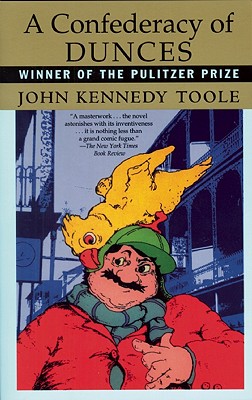
A Confederacy of Dunces and Insurgent

Reviewer: BeezusKiddo

John Kennedy Toole's A Confederacy of Dunces (1980) and Veronica Roth's Insurgent (2012) are so completely opposite that I thought it would be interesting to discuss them side by side.


Rating: 3 homemade high-quality pierogies. Well, maybe 4.

A Confederacy of Dunces is a novel by an author who loved language, and who was exceptionally skilled with language. Nothing really happens in the plot-- the main character, Ignatius Reilly, is a slovenly buffoon, who is forced to find employment after his mother causes some property damage while driving in her signature drunk fashion. Reilly first works at a pants factory, where he gets canned. Then he works as a hot dog vendor, and gets canned. None of this gets him down. The world just does not understand his GENIUS.

Reilly was funny at first, but eventually got on my nerves, mostly because I know an in-real-life Ignatius Reilly. I love a good comeuppance. Reilly never gets one, despite his selfish, egomaniacal, bombastic ways, and neither has the in-real-life Reilly I know. The lack of retribution was grating.

Confederacy has been praised as the greatest comic novel of the 20th century. I certainly thought it was funny, but I was distracted from truly appreciating its humor by my annoyance that Reilly never gets what should be coming to him.

The true delight of Confederacy is the artful language. Some gems:

In spite of whatever spiritual qualities it may possess, skid row is definitely sub-standard in the matter of physical comfort, and I seriously doubt whether my substantial and well-formed physique would easily adapt to sleeping in alleys. I would definitely tend to hang over park benches. Therefore my size itself is a safeguard against my ever sinking too low within the structure of our civilizations. [After all, I do not believe that one must necessarily scrape bottom, as it were, in order to view his society subjectively. Rather than moving vertically downward, one may move horizontally outward toward a point of sufficient detachment where a modicum of creature comforts are not necessarily precluded. I was there--on the very rim of our age-- when my mother's cataclysmic intemperance, as you well know, catapulted me into the fever of contemporary existence. To be quiete honest, I must say that since then things have been getting worse and worse. Conditions have deteriorated.

and

I recommend Batman especially, for he tends to transcend the abysmal society in which he's found himself. His morality is rather rigid, also. I rather respect Batman.

These aren't even the BEST passages. There are several more passages that are significantly funnier and more brilliant, but they are too crass for me to post here. You'll have to go read them for yourself.


Rating:1 burnt Mrs. T's Pierogi. Blech.

Whereas Confederacy is a book of amazing language and no plot, Insurgent is all action but trite language.

Insurgent follows Beatrice Prior as she leads some sort of revolution or uprising or something in the post-apocalyptic America that has been divided into separate factions according to dominant personality traits ("Candor" values honesty above all else, "Erudite" values knowledge above all else, "Dauntless" values courage above all else, "Amity" values peace above all else, and "Abnegation" values selflessness above all else.)

I've read a few reviews that compare the Divergent/Insurgent books to The Hunger Games, but Suzanne Collins as a much more compelling storyteller than Roth. Divergent kept me interested by its fast plot and novelty, but the novelty has run out in this second book. The plot is again fast-paced, but it goes in too many directions all at the same time, and there are so many characters (and none of those ever-helpful one liner reminders of who the heck anyone is) that it's easy to get lost/bored.

Insurgent is mostly told through dialog, except the dialog is overwhelmingly banter, and not even witty banter. It reminded me of the kinds of short stories I wrote in high school (which I long since abandoned, because they were terrible). I really don't like saying bad things about a book, because I know the author worked darn hard to crank out and edit the story, and I know that if the author herself weren't proud of it, she would have never had it sent to print, but I just can't like this book.

Roth credits all kind of reviewers and friends at the end of the book...and none of them could break it to her that this book is terrible? The TWIST at the end was very predictable, and the promise of learning more about that plot line isn't even enough to keep me interested in reading the next one. If anything convinces me to read the third one (when it does come out), it would just be for the sake of finishing something I have started, not because I'm enthralled by the world of Beatrice Prior.