Wednesday, April 7, 2010

Carrion Comfort, Dan Simmons (1989)

Reviewer: Elle Ewok
Rating: 4 Pierogies

Review: The following quote is on the front cover of the newest edition of Carrion Comfort:

"'Carrion Comfort' is one of three greatest horror novels of the twentieth century. Simple as that."- Stephen King.

That's one hell of an endorsement. Carrion Comfort also won the Bram Stoker Award in 1989 and is a British Fantasy Award winner and a World Fantasy Award nominee (1990). It didn't take a bunch of awards and endorsements to convince me to read this 636 page horror masterpiece though. This is Dan Simmons and it is about mind vampires. I love Dan Simmons and I love vampire stories so I was onboard from the get-go. Well, "vampires" isn't really an accurate description. The monsters in this book are not literal vampires (ha ha "literal vampires"), they are individuals that have the psychic ability to subvert the will of other humans. They can enter your mind and completely control your body and its functions, make you do whatever they want, erase your memories, read your mind, perceive through your senses and turn you into a slave basically. Those who survive describe it as a rape. These "mind vampires" or "Users" feed off the exertion of their power over others and it helps them to age slowly and remain energetic. There are only a couple dozen mind vampires in every generation but as it turns out that is more than enough to do alot of damage. It is not suprising that these mind vampires are extremely successful, rich and powerful generally (think titans of industry, famous evangelists, politicians and Hollywood producers) and that they are behind alot of the world's tragedies.

Carrion Comfort revolves around a small group of these mind vampires and their power struggles which manifest through sick and twisted "games" played with human beings as disposable pawns. [I can't type the word "pawn" withouth thinking of Stefano from Days of Our Lives, "You are my paaaawn John Black..." okay sorry]. No one is safe and anyone will be used and discarded if it suits the mind vampires' purposes - including children. There is alot of horrifying stuff going on here and it is infuriating to read about innocent decent people being used and killed in such awful ways.

However, there are good guys in this book who are fighting back led by Saul Laski, a holocaust survivor who is hell bent on tracking down an old nazi mind vampire, who not suprisingly, had a gay old time torturing residents of the nazi concentration camps with his Ability.

As with all Dan Simmons books, Carrion Comfort has a ton of characters and numerous plot lines going at once. As is also true with all Dan Simmons books, Carrion Confort is freaking awesome. Some argue that it is too long, a typical criticism of Dan Simmons. Although I usually disagree, in this case I think there are a couple of places where the story could have been shortened. The "Middle Game" portion of the book was definitely too long. I also found myself getting annoyed with the length of some of the fight sequences. There are probably a hundred or more such sequences in the book and some just wouldn't end. It got to the point where I didn't even care if anyone survived, I just wanted to get back to the story. I also didn't care about the good-guy protagonists that much. As such, despite its size, there was a lack of character development although this isn't a character study book so I didn't really care.

One thing Carrion Comfort did that I enjoyed was telling parts of the story from the points of view of two of the villians. I LOVE IT when authors so this (shout out to George R.R. Martin). Tony Harod is a slime ball Hollywood producer who uses his power mainly to rape women. Many chapters are told from his perspective although Simmons still uses a third person narrative. Many other chapters are told from the perspective of Melanie Fuller, an elderly Charleston resident and mind vampire. Her chapters are the only ones told in the first person and her chapters are the best by far.

Melanie Fuller is perhaps the most powerful and most evil mind vampire alive. The other mind vampires try to use her in their games because she seems so old, isolated and "out of it" but are soon reminded that, as in chess, the queen is the most dangerous piece on the board. Melanie's dangerous not only because of her superior abiliy but also because she is nuttier than squirrel poo. She doesn't even realized she is part of a greater power struggle (which is rather amusing) and is completely obsessed only with herself and her comfort. Her amazing powers protect her from harms that she is too self-centered and stupid to recognize. While the other mind vampires are obsessed with controlling world events and their internal power struggles Melanie just wants to live in isolated comfort and pretend that the world never changed from the segregated South she so loved. Her desires (to be left alone and live in comfort) are comparatively modest compared to some of the others but she is willing to use people in the most horrifying ways to achieve this goal. Her chapters are funny because she has all the normal old lady afflictions (thinks young girls dress like sluts, just wants to eat toast) but has no morals whatsoever. None. It is funny in a dark way how breathtaking her lack of morality is to behold being an old lady and all. She is also completely racist and says the most outrageous things. Her ability has rendered her emotionally retarded so she is also juvenile, needy and immature in many ways. All that weird baggage combined with her ridiculous power make her the most entertaining character by far.

I am not sure if Simmons was trying to make any greater social commentary in this book. Perhaps it is just coincidence that all the mind vampires are white and those fighting them are minorities (jews and blacks mainly) - but probably not. There are obvious corollaries in Carrion Comfort regarding the subrogation of minorities in society and history generally and specifically in the story. Simmons also takes alot of time in analyzing the nature of human violence and the moral implications associated sacrificing innocent life to survive and/or defeat evil (often times tying this anaylsis to the Israel-Palestinian conflict). I'm sure someone could devote alot of time and energy into studying these aspects of the book although I think it is fine to just enjoy the ride too.

Carrion Comfort is a massive book and will be a time investment to read. However, if you like horror and action and imagination I think you will find it very worth your time. I love you Dan Simmons!!!

Wednesday, March 31, 2010

House of Leaves, Mark Z. Danielewski (2000)

Reviewer: Elle Ewok

Rating: 4 Pierogies

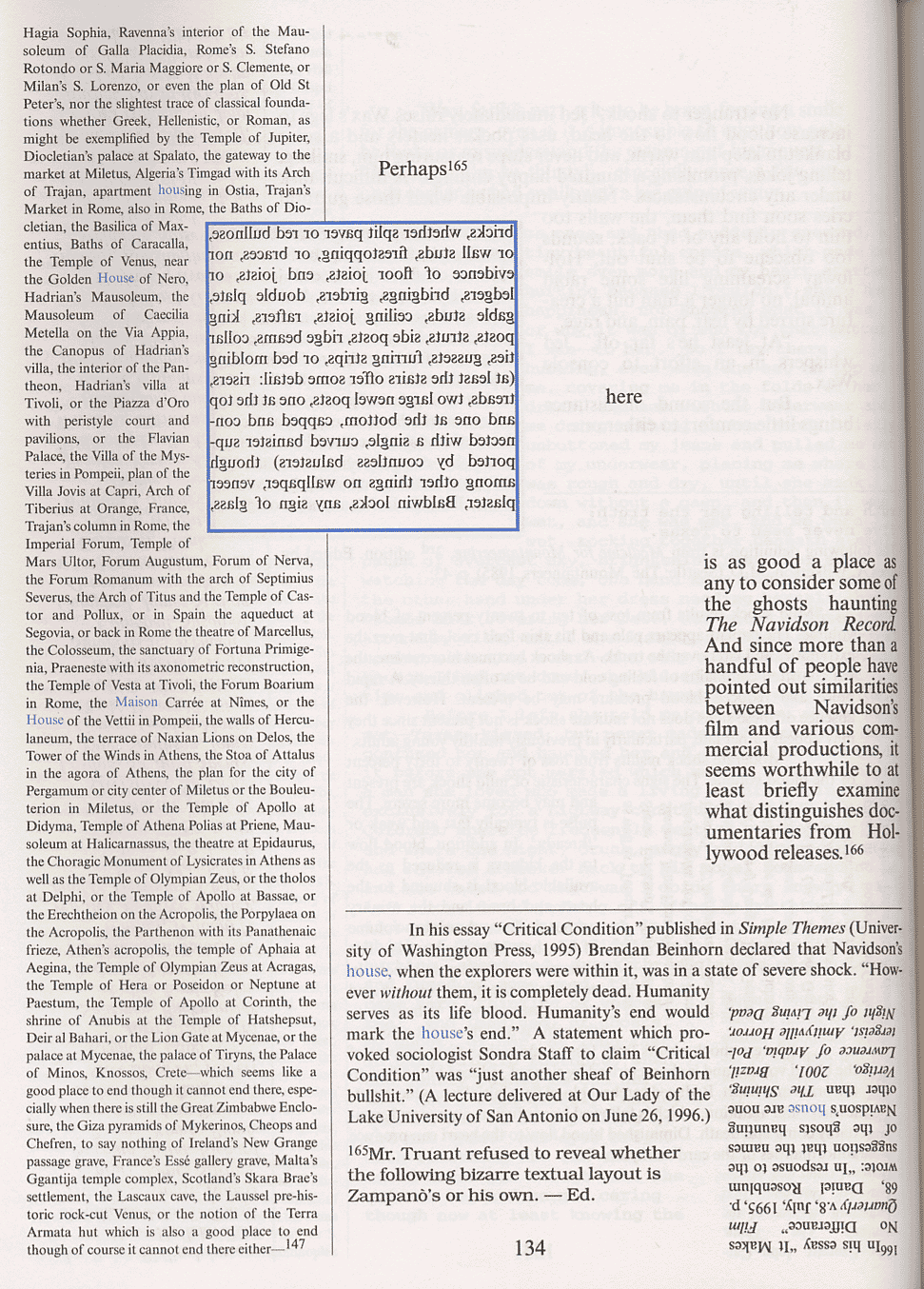
Review: House of Leaves is often described as the literary equivalent of The Blair Witch Project. This is accurate in more ways then one. First, it was released in parts on the internet thus gathering a cult following before being published as a book. Secondly, the book revolves around a home-shot horror film of unknown authenticity. House of Leaves is also known for its unusal layout, formatting and structure (and puzzles) making it oft described as "experimental" or "post-modern."

I found myself vacillating from loving the book to finding it insufferable. I still cannot decide if it is absolutely brilliant or self-indulgent, pretentious hipster fare. In the end, I think it is probably a bit of both although the flashes of brilliance that are apparent make this a book I would definitely recommend.

Johnny Truant is a tattoo parlor employee living in LA and a likely future beneficiary of Obamacare as he is someone who spends all his money on drugs and booze while complaining that he doesn't have health insurance. He is a hard-partying loser in my estimation although I guess some people may find his lifestyle cool initially. An old blind man named Zampano dies in the apartment next to his friend's apartment and Johnny ends up doing the post-mortem apartment cleanout. He finds a manuscript that is in pieces. The manuscript is essentially an academic paper deconstructing a home-shot film by a Pulitzer Prize winning photographer named Will Navidson called the Navidson Record [The character of Will Navidson is based on Kevin Carter and his famous photo of the toddler dying in the Sudan white a vulture waits in the background. The paper is complete with source footnotes and analysis of the film from famous academics and writers. The problem is there is no evidence that The Navidson Record exists and all the footnotes and quotes by famous people are fake. Johnny Truant then decides to put the Zampano's writings together and essentially edit it into a book. The rest of the book is the resulting academic paper about The Navidson Record written by Zampano and Johnny Truant's personal story told through copious footnotes.

The academic paper written by Zampano explains the content of The Navidson Record. This is pretty cool actually. Will Navidson and his girlfriend and children return from a trip to their newly purchased Virginia farmhouse only to find a closet where none existed before. Measurements of the house confirm the impossible, the inside of the house is larger than the outside. Then one day a doorway manifests in the livingroom leading to an enormous and seemingly endless space of dark and cold rooms and hallways. Will Navidson records all of this and the following explorations into the space and ultimately makes a documentary out of it - The Navidson Record. The exploration affects different people differently (madness, illness, psychosis) and not everyone survives. It is a cool concept and the allegories, imagery and symbolism of the house will leave you thinking for days after you finish the book. The academic paper though also has chapters of dense academic analysis that will probably bore many readers to tears although I think these sections are beneficial in decoding the meaning of the book. The source footnotes (and footnotes within footnotes) get pretty annoying after awhile and the bizarre layout (meant to mimic the clausterphobic and agoraphobic spatial disparaties of the house) can get pretty annoying too. Some may think it is simply gimicky and I am not positive I would disagree with them.

Johnny Truant's personal story is told through random long footnotes he interjects into Zampano's paper. It is clear Zampano's work is having very negative affects on Johnny and we basically witness his descent into total psychosis. Whether it is caused by Zampano's work, an evil force, epilepsy, mental illness or drug abuse is for you to decide. Johnny is an unreliable narrator and him interjecting his ramblings constantly can get, well... annoying. Most of his stories are about him having one night stands with strangers in graphic weird detail. This got SUPER annoying. I had no idea there were so many supposedly gorgeous women in LA just dying to have causual anonymous sex with a total loser. Who knew? I wondered if I was reading a commentary on emotionally damaged people seeking love in all the wrong places or a fratboy's creative writing seminar paper. In the end, I think the author salvaged this portion of the book for me with some good insight but he almost lost me there.

This is a book is littered with weird comments and images. Random marks abound. These are all hints of somesort to the meaning of the book. I will probably have to read House of Leaves 5 times to catch all the hints, clues ect. which is pretty cool I guess. It is fun to try to search for hints and solve puzzles.

One part of the book that entertained me significantly was Zampano's academic paper itself. I don't know if it was the author's intention to lambaste the the world of academia but holy moly did this book clearly point out everything that is wrong with the world of academia and those who inhabit it whether it meant to or not (endless self-important analysis of largely meaningless subject matters. Do we really need thousands of academic papers on a horror movie? Go do something to improve society - make shoes dammit!).

Finally, it is important to note that there are appendices and exhibits of poems, pictures and writings at the end which shed light on the story. The Whalestone Letters (which were originially published separately but now are included in House of Leaves as an appendix) are particularly revealing. They are letters from Johnny Traunt's mother to Johnny from her residence in a psychiatric ward. I had a major "AHA" moment when reading these letter. A Keyser Soze moment and it was cool. A footnote halfway through the story directs you to read the Whalestone Letters however I waited to read them until the end. I wonder how different it would have been had I read them where the author intended. Rather than having an AHA moment at the end, it would have been a slower more incremental revelation. As it stands I'm glad I waited to read them until the end.

Okay, so in conclusion yes I recommend this book. It is interesting and unique and fun. A poem included in the appendices is the only reference to the book's title that I can recall. This poem also sums up a large part of the meaning of this book (P. 563):

"Little solace comes
to those who grieve
as thoughts keep drifting
as walls keep shifting
and this great blue world of ours
seems a house of leaves
Moments before the wind."

Wednesday, February 17, 2010

...And This is Why Everyone Hates Book Reviewers

Posted By: Elle Ewok

Today is my birthday. Remember when birthdays were exciting, fun and happy occasions? Yeah, me neither.

The point is that Spudbabe got me House of Leaves (2000) by Mark Z. Danielewski for my Birthday. I have been wanting this book for a long time. Anyway, I was all excited to start reading until I skimmed the following review excerpt on the back cover:

"A rollicking Pynchonesque oddity, a Nabokovian linguistic obsession, and a Borgesian unreality. [House of Leaves] jumps and skips and plays with genre-wrecking abandon, postmodern panache, and an obsessive imaginative scope that absolutely shames most books on the market today."

Well, isn't that PRECIOUS.

"Pynchonesque"? Seriously? Look Gravity's Rainbow is on the bottom of my to-read pile and it isn't leaving that spot anytime soon. As such, this reference is meaningless to me. But not to you San Fransisco Examiner and Chronicle, oh no not to you.

There are so many aspects of this short little excerpt that make me want to vomit I am not even going to get into it. This is why you are better off reading reviews here where our contributors are Appalachian clingers who are likely too drunk to regard themselves with any sense of importance whatsoever. The only literary-adjectives created here will be in the nature of "Hogwarts-esque."

I am not sure I can bring myself to read the book anymore. First Nancy Pelosi and now this, if San Fansisco didn't have such delicious sour-dough bread I would boycott the entire city.

Thursday, January 21, 2010

Different Seasons, Stephen King (1982)

Reviewer: Elle Ewok
Rating: 3.5 Pierogies

Review: Different Seasons is a collection of four (4) novellas each related in some manner to the four respective seasons (albeit tangentially). This collection of "serious"stories was published in the early 1980s in an effort by King to demonstrate proficiency outside the horror genre. Chances are you are already familiar with most of the stories in Different Seasons as three (3) of them have been adapted into very famous major motion picture films.

A friend recommended I read this collection, claiming that although King is famous for his huge horror novels, it is in the short story medium where his true talent really shines. I have always had a bad attitude towards short stories, thinking it impossible to come up with in interesting story of value that could be told in 100 pages. Plus, I have not read too many short stories in my life that I really enjoyed (although there are some) and as a result, I usually stay away from this medium but I decided to give this collection a try and am glad I did.
I will address each novella separately below:

Rita Hayworth and the Shawshank Redemption ~ Hope Springs Eternal: I assume we are all familiar with the 1994 film adaption of this story, The Shawshank Redemption, starring Tim Robbins and Morgan Freeman. It was nominated for seven (7) Oscars but lost in all categories including best film which went to Forrest Gump. I barfed a little writing that. The Shawshank Redemption is a truly great movie, definitely on my top ten list of all time. I was extremely curious how this beautiful, painful and ultimately hopeful story could be told in less than 100 pages (this novella clocks in at 97 pages).

For those who may be unfamiliar with the movie and/or novella, the premise is extremely simple. It is the story of a falsely accused man, Andy Dufresne, who spends two horrendous decades in prison beginning in 1948, how he survives, and the friendship he develops with another inmate, Red. Ultimately, it is a story of hope in the face of unjust and seemingly endless darkness [Andy Dufresne: "Remember, Red, hope is a good thing, maybe the best of things, and no good thing ever dies."] My fiance says that line is 100% wrong and total crap by the way. Moving on...

The novella was simply lovely. The movie is basically an exact replication of King's story and dialogue. Indeed, the only differences were [spoilers] (1) In the novel Red is Irish, in the movie he is black; and (2) in the movie Andy Dufresne "got even" with the prison administration that used and abused him whereas in the story Andy simply leaves. The bad guys still suffer as a result but in a more subtle manner. I found the novella's ending in this regard to actually be more powerful even though it lacks the gratification of the movie ending. It came across to me that all the pain and suffering and horror Andy endured ultimately caused him to transcend to another level, where he had no need or desire to seek retribution. Maybe I am just overthinking it, he probably just wanted to get the hell out of there ASAP [end spoilers].

This novella can easily be read in one sitting and is well worth the small time investment even if you are already familiar with the story. The way in which King was able to tell such a beautiful and detailed story that spans decades with fully realized characters in a 97-page novella is extremely impressive and would be appreciated by anyone who loves the craft of writing. I'll leave you with the closing lines of the novella which was paraphrased in the closing lines of the movie as well. These lines always make me cry within the context of the story.

[Quote is an arguable spoiler]

Red: "I find I am excited, so excited I can hardly hold the pencil in my trembling hand. I think it is the excitement only a free man can feel, a free man starting a long journey whose conclusion is uncertain. I hope Andy is down there. I hope I can make it across the border. I hope to see my friend and shake his hand. I hope the Pacific is as blue as it has been in my dreams. I hope."

Apt Pupil ~ Summer of Corruption: At 191 pages, Apt Pupil is by far the lengthiest novella in Different Seasons and also the only story to be told in the third person (thanks Wikipedia!). The movie adaptation, also called Apt Puil and which I have never seen, was released in 1998 and stars Sir Ian McKellen and Brad Renfro (who?).

The story takes place in a fictional suburb of San Diego in the mid 1980s. Todd, an all American thirteen year old boy discovers that his elderly neighbor is a nazi war criminal in hiding. He uses this information to blackmail the old man into telling him stories, in graphic and gross detail, about his time working at a Nazi Concentration Camp. Clearly this little boy is one sick puppy and, as is obvious, so is the old Nazi. The disturbed old man and distrubed young boy develop a parasitic relationship where they reawake the dormant evil lingering inside the old man and discover an intrinsic evil growing within the boy.

The premise is solid and the story is interesting. Examining evil in unlikely manifestations is interesting (a young boy and an old arthirtic man) albeit not a totally unique idea. Although this story is about the sickness and codependancy developing between two disturbed people, it also made me think alot about the origins and capacity of human evil (which I am cerain was the point). We usually assume that criminally insane individuals were victims of some abuse and/or trauma that made them the way they are, but this novella examines instrinsic evil. The boy came from a loving home for example. Also, the old nazi reminds us of how many ordinary people willingly became instruments of the Nazi War machine and its atrocities during WWII. Watching the inherent evil develop within the boy was fascinating.

Apt Pupil is a solid and thought-provoking story although I confess that I didn't particularly enjoy reading parts of it. Parts were just too hard to read. As is the case with most psychopaths, the characters experiment in animal torture and this occured several times in the novella. As an animal-lover there is literally nothing I want to read about less than the abuse of defenseless animals. It really REALLY upsets me. I didn't think these scenes were gratuitous but I also just didn't want to read them.

Despite my discomfort with some of the gross violence in the novella, Apt Pupil is a very strong story. I found myself getting a little bored in the middle and I have read reviews arguing that Apt Pupil is too long. That said, my impatience was brief and towards the end the story engaged me completely again. I have heard some people say that the ending is was exciting and "made the story." While it certainly is exciting, I also saw the ending coming a mile away. I mean, I predicted the ending exactly right by the middle of the story. I'm no psychic, it is just that the foreshadowing was not exactly what I would call subtle.

Even though the end can be predicted by anyone paying attention it is still exciting, disturbing and worth reading. I just netflixed the movie although I will be fastforwarding through some scenes.

The Body ~ Fall From Innocence: This novella is the basis of the iconic 80s film, Stand By Me. I haven't seen the movie since I was a kid so I read the story with little understanding or knowledge of the storyline. Both the movie and the novella are hailed as a coming-of-age story and this is certainly an accurate description. I have always believed that this entire mysterious life experience on earth can be summed up in one word: bittersweet. The Body hits on this point exactly; it is an extremely bittersweet story that rings authentic. I am confient that King based this story at least partially on his own childhood experiences.

The story revolves around four preteen boys spending their last summer together before starting junior highschool. They are at that age where friendships are basically determined by age and physical proximity and that is more than good enough. The requiste factors of intellectual, personal and emotional compatability required for meaningul mature relationships aren't really factors yet. It is only when we get a bit older that we realize some of the people we spent our formidable childhoods with are totally incompatible with us. Ah, yet another bittersweet aspect of the life experience. Anyway, the boys decide to follow the railroad tracks into the woods until they find the dead body of a boy their age who was rumored to have been hit by a train and whose body hasn't been found. They are at the cusp of childhood and as such they can still believe in some magic in the world which makes their adventure all the more exciting and terrifying. As readers, we can also see that their journey through the woods is also stalked by oppressive foreshadowing which indicates the tragic ends many of them will meet in the future.
I was unable to identify with the story much at all personally. For starters I'm a girl but I also grew up in an extremely pampered suburb chuck-filled with overly involved/protective parents and teachers. The idea that I could (or would want to) disappear for 3 days in the woods with my friends and a gun to look for a dead body are completely foreign to my childhood experience. The idea that children could sustain significant physical injuries from their parents or eachother was an even crazier concept to me. That said, I became emotional reading this story and it took me awhile to figure out why. In fact, it took me two days after I finished to figure it all out. The four boys in the story reminded exactly of my fiance and his childhood friends. It was so obvious I missed it. My fiance is from a more rural area of southwestern Pennsylvania and he has childhood stories very similar to the story told in this book. Just as in the story, several of his childhood friends have met tragic fates in recent years and this is why the story affected me. When I told my fiance about my thoughts and about how one of his childhood friends in particular (who recently died tragically) reminded me of Vern from the story, he told me that Stand By Me was his friend's favorite movie and he quoted it all the time as a kid. Hearing that really made me want to cry.

I think alot of people can relate to this story either themselves or through those they love and that is why this story, whether told in the movie or the book, has become so beloved by so many. It is not a particularly exciting or unique story but it so honestly describes the bittersweet aspects of life, particularly those associated with childhood, that it kind of hurts to read.

Moving on to more specific comments...My only criticism is that King makes a big ado about how a certain aspect of their journey could be responsible for the tragic ends some of the characters meet in the future. I was really curious to see how he would pull that off. He didn't. I cannot for the life of me figure out how that part of their journey was causally connected to their fates as adults.

Another interesting part of the story from the perspective of someone who likes to study the art of writing is that the narrator is an author and includes his own fictional fiction into the story. The only other time I have seen this is in The World According to Garp by John Irving where it was done brilliantly. It makes you wonder if authors purposefully attempt to write as another person when they do this or if they take writings from a different time of their life or what. It is just interesting to think about.

All in all - highly recommended.

The Breathing Method ~ A Winter's Tale: Different Seasons concludes with, The Breathing Method - a short (63 page) story which comes the closest to the horror genre King is so well knkown for.

The narrator is a 60-something Manhattan attorney who joins a weird men's club. The club has all the usual amusements for old men (chess, brandy, books) but the members also like to tell each other strange stories.

Right before Christmas, an elderly member, who is a physician, tells a story he calls the Breathing Method. The story is about a patient of his 45 years earlier who became preganant out of wedlock. The story proceeds to reveal his admiration of her determination and strength in light of her horrible situation. Although he denies falling in love with her, it is clear the doctor did love her. The Breathing Method is essentially Lamaze, which the doctor taught his patients before it became fashionable. Unlike most patients though, this women committed to practicing and using the breathing method for her delivery.

I will not reveal the rest of the story but it is typically described as "a woman determined to give birth no matter what." In fact, that is what it says on the book's jacket. I am not sure if I am convinced that the end is about a woman's determination (although that is clearly how it was marketed). To me it came across as straight out horror. I guess it can be both.

This story was amusing but definitely my least favorite. It is very short however so it is a small time investment and it rounds out the collection.

In the end I decided to give this book 3.5 Pierogies by rating them individually and using my awesome math skills to figure out the median score.

Rita Hayworth and the Shawshank Redemption = 5 Pierogies
Apt Pupil = 3 Pierogies
The Body = 4 Pierogies
The Breathing Method = 2 Pierogies
Just like in real life, Fall and Spring are the best.

Different Seasons is definitely worth reading for Rita Hayworth and the Shawshank Redemption alone. That said, all the stories were interesting, creative and well written. Different Seasons is a worthy addition to anyone's library.

Wednesday, January 20, 2010

The Ilium/Olympos Cycle, Dan Simmons (2003 & 2005)

Reviewer: Elle Ewok

Rating Ilium: 4.5 Pierogies
Rating Olympos: 2 Pierogies

Review: Ilium (2003) and Olympos (2005) comprise a two book science-fiction series, the Ilium/Olympos Cycle, written by one of my favorite authors - Dan Simmons. Ilium won the Locus Award for best science-fiction novel in 2004 and was nominated for a Hugo Award for Best Novel in 2004 as well. Olympos was short-listed for the Locus Award in 2006.

To say I was super excited to read this series would be an understandment. I bought both doorstop books in hardcover and I saved them as a reward for myself for finishing a particularly rough month at work. Dan Simmon's novel Hyperion (1989) is not only my favorite science-fiction book of all time but one of my favorite books of all time period and I was looking forward to reading more of his work in this genre (Dan Simmons writes in numerous genres because he is awesome).

When superficially describing Dan Simmon's books to others I find they always come across wrong. They either sound boring or unserious and totally insane, neither of which are fair or accurate. In this case, the Ilium/Olympos Cycle would fall into the latter cateogory. When I explained to my father that the plot revolved around Greek Gods thousands of years in the future re-playing out the Trojan war on Mars he looked at me with sadness and disappointment and asked what happened to his "intelligent" daughter who used to obsessively read Dostoevsky. I assured him that Dan Simmons is a very intelligent author in my experience although I'm not sure Dad is convinced yet.

The two books are one story which comprise three distinct plotlines that intersect and relate in various ways throughout the books. The cast of characters is enormous. The first plot line follows the anciet battle of Troy. Except it is in the future and the Greek Gods are very real. They live on a martian volcano renamed Mt. Olympos on a terriformed Mars and are re-enacting the Trojan War soley for their own divine entertainment. The story is told, at least inititally, from the perspective of Thomas Hockenberry a 21st century Homer scholar from Indiana who was somehow brought back to life by the Greek Gods to record and report to them on how accurately their Trojan War compares to Homer's Iliad. All the Greek Gods and heros of the Trogan war are accounted for and some are even major characters in the story. Thomas Hockenberry performs his scholar reporting duties faithfully, albeit unhappily, until he is recruited by Aphrodite to murder Athena and in the process potentially finds a way to overthrow Zeus, end the reign of the Gods and stop the war. So are the Greek Gods living on Mars super-evolved and genetically engineered humans? Aliens? True Gods? You'll have to read to find out.

The second plot line follows a group of "old-style" humans living on earth. The human population on earth is strictly controlled by post-humans (evolved humans no longer living on earth) and each old-style human has a 100-year life span. They remain young throughout their 100 years due to rejuvenation technology they neither understand nor control. All their needs are taken care of by robots/machines and they live largely meaningless, immature, illiterate lives with no responsibilities much like the modern American college student. Essentially, they fax (think Star Trek's transporter beam) to various points around the globe to have huge drunken orgies and that's about it. It's alot like Spring Break Cancun 1998. One small group of old-style humans however begin to educate themselves and investigate the mysteries of their existences including the whereabouts of the unseen post-humans. As you might have guessed, this leads to all manner of danger and adventure.

The final plot line involves the loveable moravecs; artifically intelligent beings who left their creators on earth thousands of years ago ala Battlestar Gallactica and live on the moons of Jupiter. The moravecs keep to themselves generally although they are programmed to have an accute interest in human culture and the two main moravec characters happen to be obsessed with Proust and the sonnets of Shakespeare. When they notice that quantum levels on Earth and Mars threaten to destroy the galaxy they go on a mission to find out what is going on and put a stop to the quatum shananigans on Earth and Mars.

Ilium is freaking awesome. I loved it. Total vintage Dan Simmons. He comes up with a premise so interesting and creative that it leaves you shaking your head in awe. Once again I was blown away by the sheer scope of his imagination and his guts in setting out such an expansive and detailed premise. How was Olympos you ask? Eh - not so good sadly. Granted Olympos had the thankless task of bringing together the countless characters, and plot lines, and plot points, and random occurances which seemed impossible in light of the massive scope of the story. Turns out it very well was impossible because Olympos didn't deliver in the end [unlike Fall of Hyperion (1990) which totally DID deliver].

Olympos is a huge book and the first part continues to evolve the premise and scope of Ilium but not in a manner that was equally interesting. It also expands an already unwieldy set of premises and not to the story's advantage. The end of the Olympos felt very much like a rush job. Large plot lines are left unresolved, others are only partially resolved, other are resolved too quickly and sloppily, various mysteries aren't explained, the underlying science felt shaky and unclear, characters do things that don't make sense in light of their development through the story etc. It was basically all around an unsatisfying conclusion to a greatly imaginative story and world Simmons created. Additionally, there were several completely gratuitous and ridiculous sex scenes in Olympos. They wouldn't have been so bad if they didn't come across...well...kind of juevenille. For example, imagine if "Sleeping Beauty" were instead called "Sleepy Booty" and aired on Cinemax after 11PM. How would the porno prince wake the comotosed maiden? Well, read Olympos to find out. There is also a comletely pornographic sex scene between Zeus and Hera. That one, complete with graphic descriptions of Zeus's divine phallus was so ridiculous that it was just hilarious for all the wrong reasons. I read it outloud to Fiance because I knew it would embarrass him and he literally begged me to stop.

Most of the reviews I have read about the Ilium/Olympos Cycle are very favorable towards Ilium and very critical towards Olympos. Turns out I agree generally for the reasons discussed above. That said, some of the criticisms of Olympos I have come across I am not particularly receptive to. I have read several reviews claiming Olympos is anti-Islamic and even misogynistic. To this I respond with an exaggerated eyeroll. First of all, there is literally nothing more precious than self-righteous individuals claiming to care about women's rights while simultaneously refusing to allow any critical analysis of Islam out of a trendy enslavement to political correctness. But that is a side issue and I digress... I didn't see misogyny in these books.

These same people also seem to have their skinny jeans in a bunch because they think Olympos is anti-Islamic. Part of the story references a crazy time in the 21st Century where muslim extremists existed. They were violent, suicidal, anti-western and wanted to eliminate Jews from the planet. Hmmmm, gee I wonder where Simmons came up with that?? He must be prejudiced obviously, or maybe he's just watched the news at some point in the last 20 years.

What was the point of this post again? Oh yeah. Well, in closing I would recommend this series because Ilium is absolutely wonderful and the whole series is very entertaining. Just prepare yourself emotionally ahead of time for the inevitable disappointment at the end of Olympos. I did this in November regarding the 2009 Steelers season and it worked out well.

Tuesday, January 12, 2010

HAPPY BIRTHDAY SPUDBABE!!!!!


May your future be filled with many years of pierogi eating!!!

Monday, December 7, 2009

S-LYB Awesome Bookstore Series Installment #1: Eljay's Used Books (Pittsburgh, PA)

Posted By: Elle Ewok

Eljay's Used Books
1309 East Carson Street
Pittsburgh, PA 15203

The Semi-Literate Yinzer Bookclub members are very lucky in that we collectively travel a good deal. We always make a point to research whatever interesting bookstores a particular city or town has to offer and visit once we get there. In this series, we will review some of our favorite bookstores located all around the country and even abroad.

However, there is no place like home so we will start right here in our favorite city EVER: Pittsburgh, Pennsylvania.

Usually, unique bookstores are heavily advertised as must-see cultural amenities in most towns. I was recently in an amazing independant used bookstore in Asheville, N.C. (which was proudly advertised by the town tourist board) and lamenting Pittsburgh's lack of such a wonderful place. Except I was wrong. Pittsburgh DOES indeed have such a wonderful bookstore, in fact we have many. Everytime I think Pittsburgh cannot get anymore awesome IT DOES. The thing about Pittsburgh is (much like the city itself) our hidden treasures are ... well, hidden. Not because they are hard to find but because our tourist board doesn't advertise this type of stuff in any type of mass-commercial manner (nor anyone else for that matter). Let me give you an example, I was in Seattle last month and Spudbabe and I went on a "foodie" tasing tour of Belltown, Seattle. All I could think was how Pittsburgh should have such a foodie tour, particularly of the Strip District. Well a short jaunt on google and I find out Pittsburgh DOES have foodie tours, in fact we have more than Seattle. [http://www.burghfoodtour.com/]

The moral of this story is Pittsburgh has everything (including stuff alert locals don't know about) and is wonderful and better than everywhere else. Moving on...

So I have driven past Eljay's Used Books on Carson Street in the South Side many times but never stopped because finding parking in the South Side turns me into a monster and makes me want to hurt people. However, this Saturday afternoon I stopped because I promised a friend who is in town working on the new Russell Crow movie that I would take her to some great bookstores. Since she lives in LA I wanted to show her Pittsburgh's funky side, which unfortunately mandates stopping in the South Side and dealing with parking.

Eljay's is narrow and dark with highbookshelves. It smells like an attic and is cluttered. In short, it is everything a used bookstore is supposed to be. The books you ask? Beautiful. All hardcover, all in wonderful condition and all interesting editions. There are only three or four long rows of books but they are jam packed with treasures. There is only one paperback section of fantasy/sci-fi and it is well stocked and has a good selection. Almost, everything else is hardcover. There are also bizarre sections of medical books, ufo-ology, psychiatry, occult etc.

Highlights: The fiction section is amazing. Interesting editions in hardback of classics and contemporary fiction and everything in between. I could have spent all day in the fiction section alone. There is also a huge Sci-Fi/Fantasy section of hardback books as well which made me very very happy. The poetry section looked fairly impressive as well although I didn't check it out in any depth. The Military History Section was great, Boyfriend would have lost it (books seperated by war seems to lack nuance but I liked it).

Lowlights: The Children's section was not too impressive in size nor content which is too bad because strangely enough it is in the Children's section where you can find the most interesting stuff in used bookstores. Also, I didn't come across any Folklore section (if it was there it was so small I missed it) which was disappointing. Of course, as with any establishment in the South Side, the worst thing is the parking situation.

So what did I buy? I got a hardcover 1987 edition of Beloved by Toni Morrison. Cost = $6 (the same edition retails on Random House for $29.95).

Eljay's Used Books is independant and funky and located in a "cool" neighborhood (which will please the hipsters) but also has substance and selection in the major literary disciplines (which will please taxpaying squares like myself). I would count it among Pittsburgh's many unadvertised assets.

You can visit Eljay's Used Books facebook Page at: